|
|
||
|
|
Hallo again to all. Not long ago we were contacted by an editor for a large well-known American magazine. She was reviewing an article about wedding ceremonies, and wanted to explore the writer's claim that most English-language wedding ceremonies, even civil ceremonies, were rooted in the Book of Common Prayer and took most of their phrasing from there. Civil ceremonies remove references such as 'here in the sight of God' and Common Worship removes phrases like 'holy Matrimony' and 'signifying unto us the mystical union that is betwixt Christ and his Church'. The writer had claimed that no matter how secular or how contemporary the language, that English-language marriage ceremonies project the essence of the old BCP liturgy without actually including any of it.
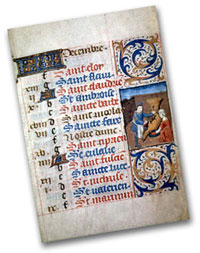
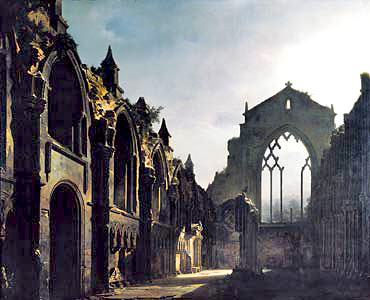
Ruins that are the vestige of something formerly great are not limited to stone buildings. There are words and concepts that survive more or less as ruins. Today on the church calendar, for example, is an important vestigial artifact of the past. Next Sunday is I Advent, which makes today the last Sunday of the church year. In the ancient tradition that is the church calendar, we are wrapping up the season called Ordinary Time*, and the last Sunday of Ordinary Time is the Solemnity of Christ the King, usually called the Feast of Christ the King or Stir-up Sunday, whose collect in the 1549 Book of Common Prayer is
Standing in a place like Rievaulx Abbey looking at the walls and stones that remain, you can use your imagination to reconstruct what the place must have been when it was a thriving Cistercian centre. Walking home from church on a day like Stir-up Sunday you can use your imagination to reconstruct what life must have been like when the church calendar was the one that people used to manage their lives. Days had names like Michaelmas and Candlemas and the Feast of St Joseph and Corpus Christi, and seasons had names like Septuagesima and Passiontide and Advent and Epiphany. Surviving terms like 'Advent calendar' usually let people remember the association between Advent and Christmas, and most people have heard of the concept of 'giving up something for Lent' but we've found that the vast majority of people don't really remember when Advent or Pentecost or Lent might be. For them, the liturgical calendar is as much an ancient ruin as the Parthenon or the crypts at York Minster. If we need to write a cheque this Friday we might try writing 'Feast of Andrew the Apostle' in the Date field, just as an experiment. But, come to think of it, we haven't seen our chequebook in a long time; it's probably in the closet next to our high-button shoes. See you next week, in Advent, in the New Year. |
 This web site is independent. It is not official in any way. Our editorial staff is private and unaffiliated. Please contact editor@anglicansonline.org about information on this page. ©2007 Society of Archbishop Justus. Please address all spam to press@anglicansonline.org |