
|
||
|
|

Basics
Start Here
Anglicans Believe ...
The Prayer Book
The Bible
News
News Centre
News Archive
Newspapers Online
Official Publications
Resources
Resources A to Z, including
Biblical Study
Book of Common Prayer
Books and Magazines
Exchanges
Events
Liturgy
Music
Religious Orders
Preaching
Theology
Youth
Worldwide Anglicanism
Anglican Communion
In Full Communion
Not in the Communion
Dioceses and Parishes
Africa
Australia
Canada
England
Europe
Ireland
Japan
New Zealand
Scotland
USA
Wales
World
Anglicans Online
Archives
Add a Site to AO
Tell Us What You Think
Link to AO
Staff
Awards and Publicity
Beginnings, AO Today
Our Sponsors
Hallo again to all.
We are several weeks into Lent, meditating about our lives, our church, and
our world. Some of us have adopted special Lenten disciplines. Some are studying. Some are ignoring the season completely. Here at Anglicans
Online we are doing what we do every week: updating our listings, hunting down the latest news and writing a few paragraphs about it.
We love what we do, but we don't think that enjoyment should require us to stop during Lent. 
This week in the news there is conflict about
radio masts on churches, there is conflict about the role of the church in society, a crisis with an animal disease and a human disease,
surveys about the religious beliefs and habits of the young, and an obituary of the oldest working priest in Britain, an archdeacon. A
priest in Africa writes a scathing condemnation of his country's church whilst Canterbury Cathedral proudly reinstalls stained-glass windows
made 'by men who knew Becket'. 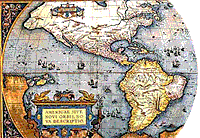
We see a pattern here, of shrinking space and increasing time. The world is becoming more homogeneous, which gives people the opportunity to disagree with those whom, a century ago, they would likely never have met. Our society had reached a balance in disease control, able to contain those known diseases that spread with known vectors. There don't seem to be major new diseases, but there are major changes in the global behaviour patterns by which diseases are spread. No livestock disease without an intermediate vector, like the flea that carried the plague, could ever have become global in a world in which no one could touch in the same week two cows that were 500 kilometres apart. To get to our Anglican point: in that world of slower travel, virtually no one knew enough about a culture half a planet away to be able to condemn it.
 As
the world grows smaller, the Bible can seem ever farther in the past. Its setting and vocabulary are increasingly alien and, because of
this, its message can be harder to communicate. There has been no shortage through the centuries of people asserting that they are bringing
the authentic word of God, but until recently they could only assert this to their neighbours. Now we can carry hate, false witness, mistakes
about God's intent, and disease viruses all over the world in a twinkling. When Moses came back from the burning bush, he was worried
about his people questioning the authority of his command from God, and all those listening to him knew him personally. Now anyone in
the world can claim to have talked to God in a modern-day burning bush, and the problem of authenticity looms much larger.
As
the world grows smaller, the Bible can seem ever farther in the past. Its setting and vocabulary are increasingly alien and, because of
this, its message can be harder to communicate. There has been no shortage through the centuries of people asserting that they are bringing
the authentic word of God, but until recently they could only assert this to their neighbours. Now we can carry hate, false witness, mistakes
about God's intent, and disease viruses all over the world in a twinkling. When Moses came back from the burning bush, he was worried
about his people questioning the authority of his command from God, and all those listening to him knew him personally. Now anyone in
the world can claim to have talked to God in a modern-day burning bush, and the problem of authenticity looms much larger.
Perhaps a vaccine for this negative globalisation is to focus on what is good about this modern world and not on what is corrupt about it; to learn how to live globally, in harmony with people who are utterly unlike us. Then we can see our Church as truly, utterly, radically global—as well as something that we walk to on Sunday mornings.
See you next week.
 |
 |
|
| Cynthia
McFarland cmcf@anglicansonline.org |
Brian
Reid reid@anglicansonline.org |
Last updated: 18 March 2001
URL: http://anglicansonline.org/